CQC Blog
Putting Advanced Primary Care Into Practice: New Guidance to Support Whole-Person Care
The California Quality Collaborative highlights updated Advanced Primary Care attributes and new operational examples designed to help healthcare organizations put whole-person, integrated care into practice.

Beyond Vaccine Hesitancy: Five Operational Strategies Pediatric Practices Can Use to Improve Immunization Performance
The California Quality Collaborative shares five practical strategies pediatric practices can use to address operational barriers, strengthen immunization delivery and improve vaccination rates while supporting families with vaccine questions and concerns.

Building Behavioral Health Capacity in Every Care Team
The California Quality Collaborative highlights how the Lay Counselor Academy is helping expand behavioral health capacity across care teams by equipping frontline staff with practical, relationship-centered skills that strengthen patient support and care integration.

Ingenuity Meets Impact: What Catalyst for Health 2026 Revealed About the Future of Health Care Transformation
CQC Executive Director Crystal Eubanks reflects on key themes that emerged from Catalyst for Health 2026, highlighting the growing importance of collaboration, implementation and shared accountability in advancing health care transformation across California.

Turning Alignment Into Action: CQC’s 2025 Impact
The California Quality Collaborative shares highlights from its 2025 Impact Report, showcasing how multi-stakeholder alignment is translating into measurable improvements in quality, equity and outcomes across California’s health care system.

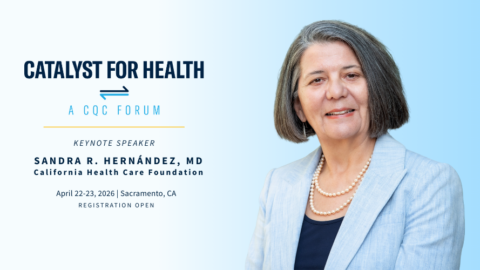
Sandra R. Hernández, MD, Named Keynote Speaker for Catalyst for Health 2026
The California Quality Collaborative announces Sandra R. Hernández, MD, president and CEO of the California Health Care Foundation, as the keynote speaker for Catalyst for Health 2026, taking place April 22–23 in Sacramento.
Defining Behavioral Health Integration in Advanced Primary Care
CQC’s new issue brief draws on insights from California and other states to inform how behavioral health integration can be implemented, supported and sustained.

Strengthening Care Where It Matters Most: What We Learned From EQuIP-LA
The EQuIP-LA evaluation shares insights from a two-year initiative that supported independent practices in strengthening primary care quality. The report highlights statistically significant improvements across key clinical measures and demonstrates how targeted, equity-centered support can build lasting capacity for improvement.

Advancing Equity-Centered Primary Care Through Practice Transformation
EQuIP-LA supported independent practices in advancing equity-centered primary care through community-driven quality improvement. The initiative generated practical tools and real-world strategies that teams can use to design equity-focused projects and strengthen care delivery.

Strengthening Pediatric Behavioral Health Integration: New Toolkit for Providers
The BHI-CYCLE Toolkit was developed from a statewide collaborative to help providers integrate behavioral health into pediatric primary care. The toolkit highlights seven key areas and features case studies from providers across California.

CQC Releases New Building Resiliency Toolkit on CA Path
CQC’s Building Resiliency Toolkit helps frontline providers and care teams strengthen adaptability, prevent burnout and embed sustainable practices—supporting healthier teams and better care across California.

Scaling Behavioral Health Integration Across California
CQC’s Behavioral Health Integration Initiative reached over 730,000 Californians in 2024 by helping primary care teams expand screening, improve access and deliver more equitable care—strengthening whole-person health across communities.

Turning Shared Goals Into Real-World Results: CQC’s 2024 Impact
CQC’s 2024 efforts supported more than 932,000 Californians through initiatives that advanced value-based payment, expanded behavioral health access and helped providers embed equity into quality improvement—driving results across regions and populations.

Driving Access Through Innovation: Tweedy Medical Group’s Story
Tweedy Medical Group, a primary care clinic in Los Angeles participating in the EQuIP-LA initiative to reduce disparities for Medi-Cal enrollees of color, launched a nonprofit to eliminate medication cost barriers and partnered with a local pharmacy to improve access, outcomes and patient engagement.

Closing Gaps and Centering Equity: Reddy Care Medical’s Story
Reddy Care Medical, a primary care practice in Los Angeles participating in the EQuIP-LA initiative to reduce disparities for Medi-Cal enrollees of color, trained community health workers, addressed key social needs and strengthened care coordination to advance more equitable, patient-centered care.

Transforming Medicare in California: Pathways to Improvement
In its new issue brief, the California Medicare Collaborative, a multi-stakeholder effort was dedicated to improving care for residents insured solely by Medicare, including duals, non-duals and those in both traditional Medicare and Medicare Advantage programs, provides recommendations to address the complex needs of the population.

Strengthening Health Equity through Primary Care Transformation
Strategic investments in primary care, as demonstrated by the California Advanced Primary Care Initiative, enhance health care equity and quality through collaborative efforts among health plans, providers and purchasers.

Whole-Person, Team-Based Care: Transforming Delivery with BHI Advisory Group Member Dr. Neftali Serrano
Dr. Neftali Serrano, CEO of the Collaborative Family Healthcare Association and member of CQC’s Behavioral Health Integration Advisory Group, is a leading advocate for team-based care, dedicated to creating a more cohesive and patient-centered health care delivery system.

Pain, Perseverance and Patience: Michelle’s Story
Steering committee member of CQC’s Equity and Quality at Independent Practices in LA County Michelle Rosser is championing better health care for herself and her community.

Inside CHOC Children’s Well Spaces: School-Based Mental Health in Youth with CQC Steering Committee Member Dr. Mike Weiss
Dr. Mike Weiss, Vice President of Population Health at Children’s Hospital of Orange County (CHOC), has been a key member of the steering committee for over a decade, four years of which he served as committee co-chair. At CHOC, Dr. Weiss’ team leads the innovative Well Spaces program, a proactive approach to tackling youth mental health challenges within the school environment.

A Journey of Resilience and Advocacy in a Complex Health Care Landscape
When David Ford received a life-altering colorectal cancer diagnosis in 2015, he was thrust into the complex world of navigating the health care delivery system which revealed significant disparities especially prevalent in minority communities.

Exploring Capitated Payment for Primary Care in California
Hybrid payments that include capitation offer a promising alternative to traditional fee-for-service models, focusing on quality over quantity to enhance patient outcomes and system efficiency.

Empowering Care: The Role of Alternative Payment Model Design in Advancing Equity
Alternative Payment Models (APMs), incentivizing clinicians to provide high-quality, cost-efficient care beyond traditional fee-for-service payments, hold immense potential to revolutionize health care delivery, expanding access, improving outcomes and addressing health disparities.

From Data to Delivery: Measuring Advanced Primary Care in California
CQC and IHA executed a pilot project in California, bringing together four large health care purchasers — Covered California, California Public Employees’ Retirement System (CalPERS), eBay and San Francisco Health Services System — and 13,055 primary care practices.

Advanced Primary Care Key to Reducing Health Inequities
Robust, comprehensive primary care – a critical foundation for a more cost-effective, high-functioning health system – is equally important in helping boost health equity.

Better Data Collection Essential to Understanding and Addressing Health Inequities
The ability to effectively collect a range of data points about patients and the care they receive is essential.

5 Lessons for Achieving High-Quality Virtual Care
A new report presents five lessons to support the long-term use of telehealth services as a tool to deliver high-quality virtual care.

8 Steps to Implementing Advanced Primary Care
Despite these outsized benefits, misaligned financial incentives, chronic under-investment, infrastructure barriers and a lack of integration with other elements of care continue to severely constrain primary care’s impact on the health of American workers and families.

Strengthening Primary Care: A Pilot with Four Large Purchasers
Together with the Integrated Healthcare Association (IHA), PBGH brought together four large health care purchasers in California to pilot this set of performance measures that emphasize patient experience and outcomes.

Using Primary Care’s Potential to Improve Health Outcomes
Through successive initiatives and in collaboration with a diverse group of committed stakeholders, PBGH has spearheaded efforts to create a blueprint for “advanced primary care.”

Opportunities in COVID-19 Vaccine Access and Equity
Health care leaders are looking to work together differently to ensure COVID-19 vaccines are delivered in an effective, equitable manner.

How Primary Care Providers Can Improve Depression Screening
Depression screening is an essential tool for primary care providers to better understand and meet their patients’ needs.

Patient Experience and Telehealth During COVID-19: Investigating Key Success Factors and Obstacles
Telehealth holds great promise for improving primary care through increasing access, improving patient experience and enabling team-based care models.

Addressing Social Determinants of Health Essential to Reining in Health Care Costs
Health care’s exorbitant costs can never be controlled without fundamentally shifting society’s focus toward the underlying social and economic conditions.

The Current State of Mental Health Screening and Access in California: Results from 35,000 Patients
Mental health concerns are increasingly common, yet many patients in California are not screened for symptoms and are unable to access treatment.
Is Shorter Better When it Comes to Collecting Patient Feedback?
Patient experience is an important quality indictor, both for provider organizations and patients. The benefits to patients include better disease management, quality of life, treatment adherence, outcomes and preventive care.

Designing and Offering Responsive Telehealth Support
Working closely with California provider organizations, the Pacific Business Group on Health’s California Quality Collaborative (CQC) designed technical assistance webinars supporting primary care practices rapidly implementing and optimizing telehealth.

Primary Care Practices Can Engage Patients in Virtual Care
During the most challenging phases of the COVID-19 pandemic, one opportunity for the health care delivery system has been the rapid adoption of telehealth and virtual care by both primary care practices and patients.

Doctors Expect to Use Telehealth More Extensively Post COVID-19
Telehealth is quickly emerging as an important clinical tool for physicians scrambling to adapt to the COVID-19 pandemic. Both patients and physicians report being happy with treatment delivered via telehealth, but doctors say barriers to adoption still exist.

Telehealth Providing Critical Pregnancy Support During Pandemic
Telehealth has emerged as a vital tool for helping expecting mothers and clinicians manage pregnancy in the time of COVID-19.